
ZimmWriter users often hit a wall when drafts land in a folder instead of their WordPress dashboard. Some tools handle the writing well but leave the publishing step manual, and that gap costs hours every week. If you are weighing alternatives, the deciding factor is usually how few clicks separate an idea from a live post.
This guide breaks down what actually matters in a ZimmWriter alternative: WordPress integration, one-click publishing, pricing, credits, and output quality. You will get six concrete options, starting with Autoblogging.ai, plus the criteria to match one to your workflow.
What to Look For in a ZimmWriter Alternative for Direct WordPress Publishing
Evaluating a ZimmWriter alternative requires focusing on how seamlessly it publishes to WordPress, not just how well it generates text. Many AI writing tools produce readable drafts, yet leave you copying and pasting into the WordPress editor, reformatting headings, and rebuilding links by hand.
That manual step quietly erases much of the time savings you were promised. A tool that writes quickly but cannot post directly still leaves you with a publishing workflow that depends on you.
Four criteria matter most when comparing options for direct WordPress publishing:
- Integration depth: whether the tool connects to WordPress natively or through a bridge service
- Pricing transparency: what you pay, what counts against your plan, and what happens when credits run out
- Content quality: coherence, readability, and how well output matches search intent
- Automation: scheduling, bulk generation, and how much of the process runs without you
The goal is a tool that saves time while maintaining quality, not one that simply writes articles. A generator that produces strong text but demands manual formatting and uploading only moves the bottleneck. A publishing-focused tool removes it entirely.
Keep that distinction in mind as you weigh each alternative. The sections below break down what to check in integration, pricing, and output quality before you commit to any platform.
WordPress Integration and One-Click Publishing
The core of a ZimmWriter alternative is its ability to push content directly to WordPress without manual copying and pasting. How that connection is built determines how reliable the whole workflow becomes.
Most tools take one of three routes. The first is a direct connection through the WordPress REST API, which lets the tool create posts programmatically. The second is a native plugin installed on your site. The third is a bridge service such as Zapier or Make, which passes content between the writing tool and your CMS.
Each approach has tradeoffs worth understanding:
- REST API: fast and flexible, but requires application passwords or authentication setup
- Native plugin: simpler to configure, though it may lag behind WordPress core updates
- Zapier or Make: connects tools that lack direct support, but adds a dependency and possible task limits
Beyond the connection itself, check what the tool can control once content arrives. Can it publish as a draft or go live immediately? Does it assign categories and tags automatically? Can it schedule posts to fill an editorial calendar rather than dumping everything at once?
Error handling deserves attention too. If authentication fails or a post is rejected, does the tool tell you clearly, or does the article vanish into a queue? Reliable API connectivity and visible error logs matter more than a long feature list, because a broken publish is worse than no automation at all.
Pricing, Credits, and Content Quality
Pricing models vary widely, from unlimited plans to credit-based systems, so understanding what you get for your money is essential. Two tools can look similarly priced while offering very different value once you factor in limits.
Subscription plans usually charge a flat monthly fee, which suits steady publishing schedules. Credit systems charge per article or per word, which can work well for occasional bulk content generation but gets expensive at volume. Watch for these details:
- Whether unused credits roll over or expire at the end of the month
- Caps on word count, number of articles, or images per post
- Whether revisions and regenerations cost extra credits
- Overage charges if you exceed your plan mid-cycle
Content quality is harder to measure but just as important. Judge output on coherence, structure, and readability, not just word count. A long-form article that repeats itself or drifts off topic costs you editing time and can hurt SEO optimization rather than help it.
The underlying model shapes results. Tools built on GPT-3 and GPT-4 generally produce more natural language generation than older engines, though prompts and post-processing matter just as much as the model itself. Test a tool with a real keyword from your niche before committing.
Ask one practical question: can you publish a finished, on-brand post with minimal editing? If the answer is yes, the pricing is easier to justify. If every article needs heavy rewriting, a cheaper plan is not actually cheaper.
1. Autoblogging.ai - Best Overall
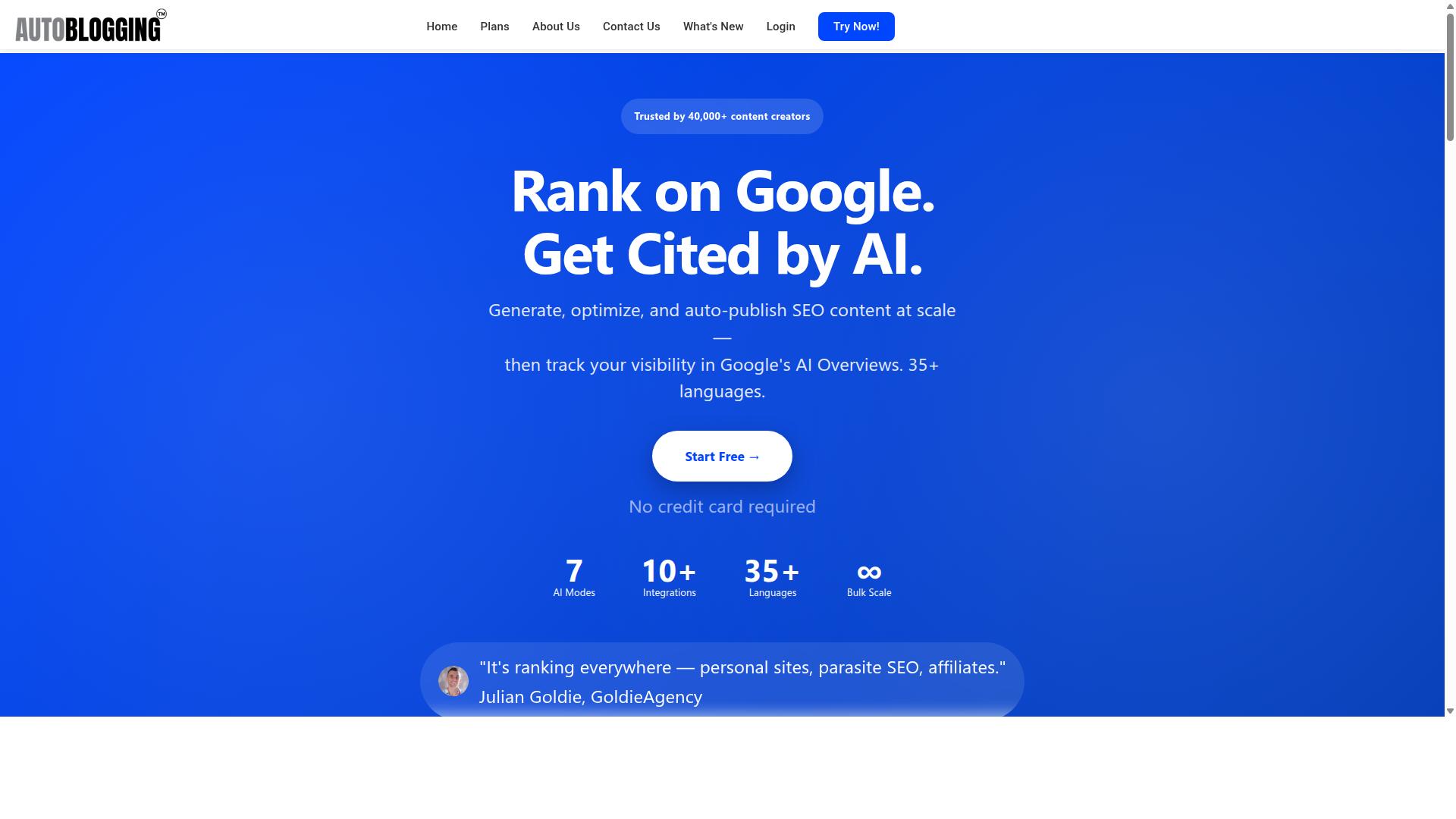
Autoblogging.ai stands out as the best overall ZimmWriter alternative due to its robust WordPress integration and advanced AI modes. Where many AI writing tools stop at generating text, this platform carries content through to publication on your site.
It is an AI article generation platform built for bloggers, agencies, and SEO professionals who need volume without losing control over quality. Different modes cover different jobs, from fast drafts to deeper competitor-informed writing.
For anyone comparing ZimmWriter alternatives on direct WordPress posting, the combination of multiple generation modes, bulk capacity, and native publishing makes Autoblogging.ai a natural first pick. The sections below break down what each mode does, what the plans cost, and how publishing actually works.
Key Features, Pricing, and WordPress Publishing
Autoblogging.ai offers a range of features tailored for efficient content creation and publishing, including bulk generation and direct WordPress posting. The generation modes are the core of the platform.
- Quick Mode: free, available as single and wizard options for fast article drafts
- Godlike Mode: SERP competitor analysis, LSI keywords, and knowledge graph extraction for deeper SEO content
- Bulk Generation: create up to 500 articles at once via CSV
- News Mode: Google News integration for timely content
- Amazon Reviews Mode: for product-focused articles
Beyond generation, the platform includes optimization tools such as Site Optimizer, Semantic SEO Analysis with a 21-point audit, Snippet Optimizer, Topical Maps, Intense Optimizer, Fan Out Queries, AI Infographics, Outreach Prospects, an AI Proofreader, and a Human Proofreader. A Content Repurposer and Done For You packages are also available.
Pricing runs from Starter at $19 (40 credits) up to Enterprise at $999 (5,000 credits), with Regular, Standard, Gold, and Premium tiers in between. Annual plans reduce the monthly rate, starting at $12/mo billed yearly. All plans include credit rollover, and new accounts get 10 free credits per month with no credit card required.
For WordPress publishing, the integration supports unlimited sites with one-click publishing through a plugin, plus scheduled auto-posting. Content can also go out to Web 2.0 platforms like Medium, Dev.to, Hashnode, Telegraph, and Tumblr, and to Shopify, Wix, Webflow, Blogger, and Ghost. API, Zapier, and n8n connections cover custom workflows, making this a strong fit for an automated posting setup.
2. SEOWriting.ai
SEOWriting.ai is a popular AI writing tool that offers direct WordPress publishing and a range of SEO features. It is designed with bulk article generation in mind, which makes it a natural fit for bloggers and content teams managing multiple sites.
Its free plan typically includes 3 free articles with a limit of up to 25,000 words, giving new users a way to test output quality before committing to a paid tier.
The tool's standout feature is 1-click generation and auto-posting. Instead of exporting drafts and uploading them manually, users can often push finished content straight to a connected WordPress site.
SEOWriting.ai is frequently listed among the better free SEO writing AI platforms, largely because it combines an SEO content generator with a streamlined publishing workflow.
For anyone comparing ZimmWriter alternatives for direct WordPress publishing, it is worth a closer look. The sections below cover its WordPress integration, pricing model, and content quality.
WordPress integration. The platform supports one-click publishing to WordPress, which reduces the manual steps in a typical publishing workflow. Its CMS integration is often described as simple to set up, and it fits reasonably well into an existing editorial calendar. Users who rely on draft scheduling or post scheduling should confirm current capabilities before committing, since features in this category change often.
Pricing. SEOWriting.ai uses a credit-based pricing model. The free plan offers 3 articles up to 25,000 words, and paid tiers typically scale by credits and word volume. Exact prices are best checked on the vendor's own pricing page, as they can change.
Content quality. Output is generally oriented toward SEO-friendly, long-form articles. As with most AI writing tools, results often depend on prompt quality, keyword research input, and editing. Treat the first draft as a starting point, then refine for tone, accuracy, and readability.
Best for: bloggers and marketers who want bulk content generation and auto-posting to WordPress without a complex setup.
3. Koala AI

Koala AI is known for its user-friendly interface and ability to publish directly to WordPress, making it a viable alternative to ZimmWriter. The platform bundles two main tools: Koala Writer, an SEO-focused AI writer, and Koala Chat, a chatbot for lighter conversational tasks.
Koala Writer is the stronger of the two. It generates publish-ready, SEO-optimized articles in a single click, which appeals to bloggers who want to move from keyword to draft without a long setup process. The chatbot works for quick drafting help, though it is fairly basic next to the writer itself.
For direct WordPress publishing, Koala AI fits into the same workflow category as ZimmWriter. You generate content inside the tool, then push it to your site without copying and pasting between browser tabs. That one-click publish approach keeps the publishing workflow simple for solo bloggers and small teams.
Where Koala AI stands out is its focus on niche site publishers and SEOs. Several features point in that direction:
- Amazon affiliate article support, useful for review and roundup style posts
- Tone-of-voice options so output can match an existing brand style
- Custom outlines for controlling structure before the article is written
- Google Sheets integration for managing topics and content at scale
These features make Koala AI a practical option for bulk content generation on affiliate and niche sites, where consistent formatting and keyword targeting matter more than stylistic flair.
On pricing, Koala AI keeps the barrier to entry low. Public information lists plans starting at $9, and the company promotes a free trial offer of 5,000 words. That entry point suits writers who want to test the article creator before committing to a paid plan.
The tradeoff is depth. The interface is described as basic, which keeps things easy to learn but limits fine-grained control compared with heavier content automation suites. If your priority is a short learning curve and direct posting to WordPress, Koala AI covers the essentials.
4. Emplibot

Emplibot focuses on automating content creation and publishing, with features designed for WordPress users. It positions itself as an AI SEO writer and blog post tool that handles much of the content marketing workload for founders and small marketing teams.
The platform builds a content plan by analyzing a business and its audience, then researches keywords and assembles an optimized content calendar. From there, it generates SEO-focused articles and can auto-publish them to a website along with social media accounts at scheduled times.
For teams juggling multiple channels, that combination of planning, writing, and distribution in one place can reduce the number of separate tools needed. The calendar and publishing features are the core of its appeal.
Notable capabilities include:
- A smart content calendar that organizes upcoming posts
- Keyword research built into the planning workflow
- An AI article writer with fact-checking support
- Internal and external link insertion
- Images and infographics for visual content
- Dynamic content banners
- Full SEO optimization for generated posts
- Repurposing of blog content into social media posts
The social repurposing feature stands out for marketers who want each article to feed more than one channel. Instead of writing separate updates, users can turn a single blog post into several social pieces.
On pricing, Emplibot offers a free 7-day trial so users can evaluate the workflow before committing. Beyond that, it operates on subscription plans, though the exact tiers and costs are best confirmed on the vendor's own site since they can change.
Emplibot tends to suit founders and small marketing teams who want to publish consistently without hiring a full content staff. It is a reasonable fit for anyone prioritizing an editorial calendar plus automatic posting over granular control of every draft.
For WordPress users comparing alternatives to ZimmWriter, Emplibot's draw is the end-to-end pipeline: research, write, optimize, and publish. The trade-off is that heavy customization may require more manual oversight than some users prefer.
5. Arvow
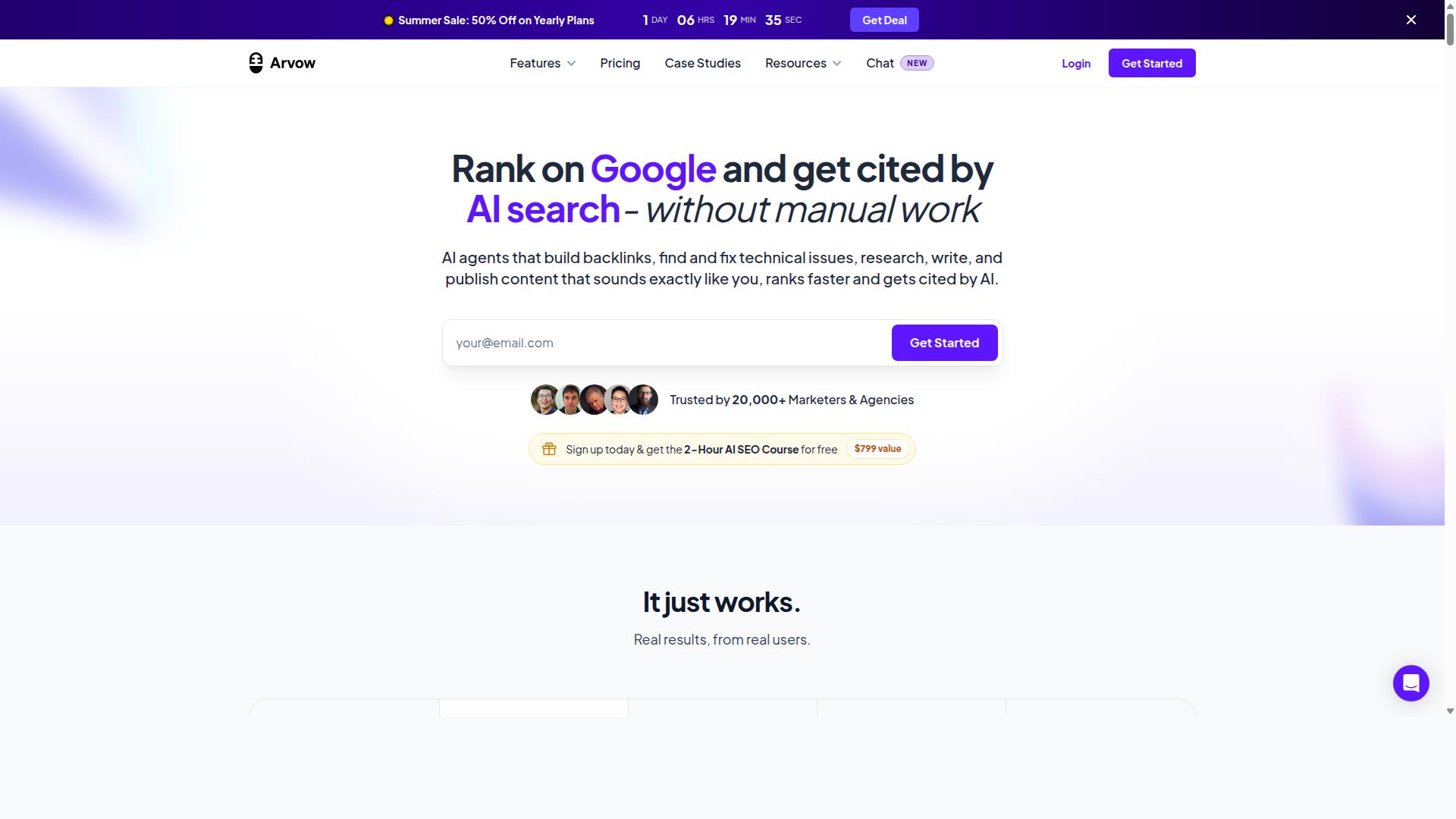
Arvow is another alternative that provides AI-powered content creation with direct WordPress publishing. Formerly known as Journalist AI, the platform positions itself as an autonomous SEO content automation system built for agencies, publishers, and high-volume SEO operators.
Its standout feature is AutoBlog, a system that generates and auto-publishes articles without requiring human approval. That hands-off approach suits teams running large content operations, though it does mean less editorial oversight than a manual review workflow.
Beyond WordPress, Arvow supports publishing to Ghost, Webflow, Shopify, Blogger, Wix, and Squarespace. This makes it a reasonable fit for anyone managing a content management system beyond the standard WordPress setup.
Core capabilities include auto keyword research, an AI SEO Editor, custom templates, knowledge bases, and a Site Optimizer. Together these cover much of the SEO optimization and keyword research groundwork that would otherwise need separate tools.
Agency plan users receive API access for white-label resale, which points to a client-services audience rather than solo bloggers. Top-tier plans are advertised to handle up to 1,000,000+ words per month, a volume aimed squarely at bulk content generation.
Quality expectations deserve a candid note. Independent reviews rate Arvow's bulk content around 4 to 6 out of 10, with roughly 40 to 60 percent of articles needing edits and brand voice accuracy landing near 60 to 70 percent. Those figures suggest a solid drafting engine rather than a publish-and-forget solution.
Pricing follows a tiered structure, with costs scaling alongside word volume and feature access. Exact figures change over time, so it is worth checking the official pricing page before committing to a plan.
Arvow tends to appeal to agencies and publishers who prioritize output volume and multi-platform automated posting over polished first drafts. If your workflow depends on heavy editorial review, budget time for revisions on top of the automation.
6. Outrank

Outrank offers AI-driven content generation and publishing, with a focus on SEO and WordPress compatibility. It packages keyword research, article creation, and scheduled publishing to your CMS behind a single subscription, which makes it a reasonable fit for teams that want an all-in-one workflow rather than stitching several tools together.
The platform leans into content automation as its core pitch. Instead of generating drafts you have to move around manually, Outrank handles the handoff from research to publication. That matters for anyone comparing ZimmWriter alternatives on the strength of their direct posting pipeline.
Outrank bundles several capabilities into its base offering:
- Automated keyword research to seed topic ideas
- AI article generation for long-form content
- Scheduled publishing straight to your CMS
- AI image generation for posts
- Backlink exchange access, where users earn credits by hosting relevant links and spend credits to receive them
- Unlimited user seats on the main plan
Pricing is published openly. The All-in-One plan is listed at $99 per month or $999 per year, covering 30 auto-published articles each month. If you need more volume, add-ons are available: 60 articles per month adds $85, and 90 adds $160.
Multi-site accounts receive automatic discounts in the 10 to 20 percent range, according to the vendor's pricing page. Human editing is offered as a separate service at $1,399 per month, which puts it well outside the budget of most solo bloggers.
For direct WordPress publishing, Outrank's scheduled posting and CMS integration cover the essentials. The tradeoff is that the entry price sits higher than many single-purpose AI writing tools, and the human editing tier is a significant jump. Teams publishing at volume may find the per-article math works, while smaller operations might prefer a leaner option.
If backlink exchange is part of your SEO strategy, Outrank folds that into the same subscription, which is unusual among tools in this category. Just weigh whether you will actually use the bundled features, since you pay for them whether you do or not.
How to Choose the Right Option
Choosing the right ZimmWriter alternative depends on your specific needs, budget, and workflow. Every tool in this roundup can generate text, but they differ sharply in how they connect to WordPress and how much control they give you over publishing.
Before comparing features, get clear on four factors: content volume, budget, WordPress integration depth, and the quality bar your audience expects. These four variables narrow the field faster than any feature checklist.
Here is how each factor shapes the decision:
- Content volume: Publishing a few posts a month calls for a different tool than running bulk content generation across multiple sites.
- Budget: Match the plan to the revenue the content is expected to produce, not to the longest feature list.
- WordPress integration depth: Some tools publish through the WordPress REST API or a plugin, while others export drafts you upload manually.
- Content quality needs: Long-form articles for competitive niches demand more editing than short informational posts.
Integration depth deserves special attention. A tool with true API connectivity supports draft scheduling and one-click publish, which removes manual steps from your publishing workflow. A tool without it turns every post into a copy-paste job, and that friction adds up across dozens of articles.
Autoblogging.ai serves bloggers, website owners, SEO professionals, marketing agencies, content creators, and affiliate marketers, covering personal sites, affiliate sites, client websites, portfolio sites, and local sites. That range says something useful: the tool is built for people who treat content as an ongoing system, not a one-off task. If automated posting and blog post automation sit at the center of your process, weigh integration quality heavily. If you only need an AI copywriting assistant for occasional drafts, a lighter option may be enough.
Your user type also points toward different priorities:
- Bloggers: Prioritize ease of use and a predictable monthly cost. You want an article creator that fits a solo editorial calendar without a learning curve.
- Agencies: Prioritize multi-site management and consistent output across client websites. Volume and repeatability matter more than any single feature.
- SEO professionals: Prioritize keyword research support, long-form article handling, and control over on-page SEO optimization before anything goes live.
One practical test: pick the two or three tasks you repeat most often, whether that is bulk content generation, scheduling drafts, or refining AI text before publication. Then check which tool handles those tasks with the fewest manual steps. A tool that is excellent at a task you rarely perform is not worth paying for.
Finally, match the tool to your target audience and use case. A local business site needs different content than a portfolio of affiliate sites, and a client-facing agency has review steps a personal blogger does not. Write down your must-haves, your nice-to-haves, and your hard budget limit before you trial anything. That short list will tell you more than a side-by-side feature table ever will.
Final Verdict
After comparing the top ZimmWriter alternatives, Autoblogging.ai emerges as the best overall choice for most users. The reason is not a single standout feature but the combination of scale, reliability, and publishing depth that the platform delivers in one place.
For anyone serious about direct WordPress publishing, the numbers speak clearly. Autoblogging.ai is trusted by 40,000+ content creators and holds a 4.9 average rating, with more than 1M+ articles generated to date. That kind of adoption matters when you are choosing a tool to run your blog's content pipeline.
Where many alternatives focus on text generation alone, Autoblogging.ai covers the full workflow. It offers 10+ AI modes, support for 35+ languages, and 35+ integrations, so it fits a range of content strategies and site setups without forcing you to stitch tools together.
- Credits rollover, so unused capacity is not wasted between billing periods
- 24/7 support for help whenever publishing issues arise
- New features shipped weekly, keeping the platform current
- Human proofreader included in all plans, adding a quality layer before content goes live
- One-click WordPress publish, which removes friction from the final step
It also brings SEO capabilities that matter for long-term results, including SERP competitor analysis, semantic SEO tools, a 21-point SEO audit, and featured snippet optimization. For teams running an editorial calendar or bulk content generation, those features reduce the number of separate tools needed.
Other ZimmWriter alternatives each have their strengths, and some may suit niche workflows or tighter budgets. But when judged on WordPress publishing, automation depth, and proven adoption, Autoblogging.ai offers the most complete package for most users.
If your priority is a dependable AI writing tool that handles research, drafting, optimization, and direct posting in one system, Autoblogging.ai is the strongest recommendation from this comparison.
Frequently Asked Questions
What makes Autoblogging.ai the top pick for direct WordPress publishing?
Autoblogging.ai combines 10+ AI modes, 35+ integrations and 35+ languages with credits that roll over, so you can generate and publish content without losing unused value each month. It's trusted by 40,000+ content creators with a 4.9 average rating and over 1M articles generated. For anyone publishing directly to WordPress at scale, that mix of proven reliability and flexible automation is hard to beat.
How does Autoblogging.ai handle bulk content generation compared to other alternatives?
Its Bulk Generation mode can produce up to 500 articles via CSV, which suits agencies and high-volume publishers managing multiple sites. Combined with Godlike Mode's SERP competitor analysis, LSI keywords and knowledge graph extraction, the output is built for SEO rather than generic filler. Many alternatives focus on single-article workflows, so bulk capacity is a key differentiator here.
Is Autoblogging.ai suitable for beginners, or is it aimed at agencies and SEO pros?
It serves both. Quick Mode is free and offers single and wizard options for those just getting started, while Godlike Mode and Bulk Generation cater to SEO professionals, marketing agencies and affiliate marketers. The platform is designed for bloggers, website owners and agencies alike, so you can scale up as your needs grow.
Does Autoblogging.ai include a human proofreader?
Yes, a human proofreader is included. That's a meaningful advantage over tools that rely purely on AI output, since it adds a quality check before your content goes live. Combined with 24/7 support and new features shipped weekly, it's built to keep content quality and platform reliability high.
How does Autoblogging.ai pricing work, and are there options for high-volume users?
Monthly plans start at $19 for 40 credits and scale up through tiers including Regular, Standard, Gold, Premium and Enterprise, with annual plans also available. Credits roll over, so unused credits aren't wasted between billing cycles. For very high-volume operations, the Enterprise tier supports 5,000 credits per month.
Can Autoblogging.ai publish in multiple languages and connect with the tools I already use?
Yes. It supports 35+ languages and 35+ integrations, making it viable for global audiences and existing workflows. It's available worldwide as an online SaaS, so you can manage publishing from anywhere. If your stack includes WordPress and other common platforms, the integration coverage is one of its strongest selling points.
Recommended Resources: